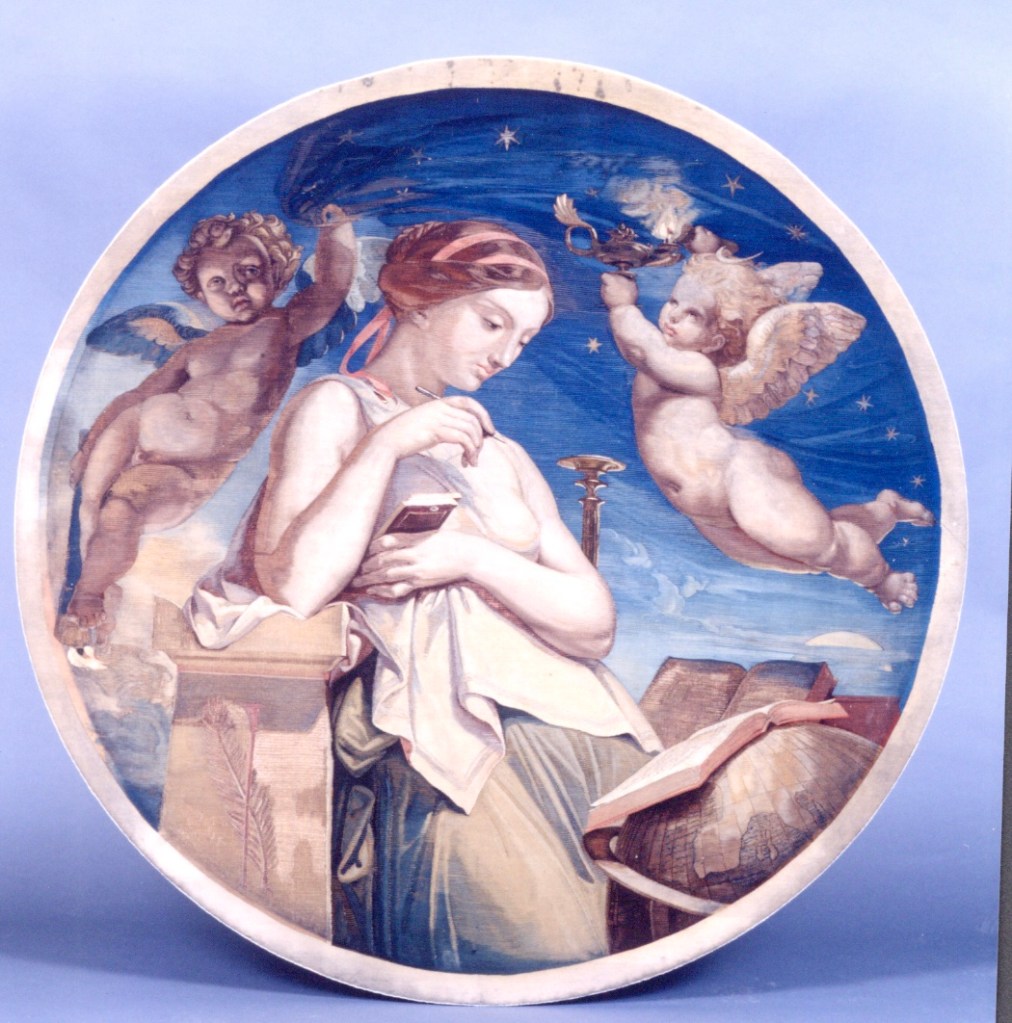
L’étude surprise par la nuit, une tapisserie tissée entre 1850 et 1853 (époque de l’ouverture de la bibliothèque, Sainte-Geneviève, Paris) à la manufacture des Gobelins sur un carton des frères Paul Balze et Raymond Balze. (See Mobilier National).
This is an image well worth a flight to Paris, or at least a dream thereof. As the label notes, it is a tapestry but as not noted, it sits behind the busy reference desk in a reading room that literally has a waiting line. The interior is dark and dreamy, and the tables have the light fixtures similar to those Virginia Woolf remembered in Three Guineas. The subjects in the tapestry address the dual charges of archivists: both to protect the record and to ensure that the record is accessible. And that mandate, tenebrae et lux, I once read in those exact words and never could find again. Can you?
The tapestry itself, in the words of Thibault Keromnès, Chargé de la formation des usagers chez Bibliothèque Sainte-Geneviève, tells more, writing that:
[The tapestry] is an allegory of knowledge whose links with the Sainte-Geneviève library are strong. The universalism of knowledge, symbolized by the globe on which the book studied is open, refers to the encyclopaedism of collections. The theme of the night is present throughout the library, which was among the first public establishments to open late at night thanks to gas lighting. Here, an angel brings light to allow study to continue, to allow students to read, something that is echoed in many other decorative elements (the torches at the entrance to the library, the stars on the ceilings of the grand staircase, the busts of women in the Labrouste room, some of whom have their eyes half-closed).
Or, his words copied from email to Susan Tucker:
C’est une allégorie de la connaissance dont les liens avec la bibliothèque Sainte-Geneviève sont forts. L’universalisme de la connaissance, symbolisée par le globe sur lequel est ouvert le livre étudié, renvoie à l’encyclopédisme des collections. Le thème de la nuit est présent dans toute la bibliothèque, qui a fait partie des premiers établissements publics à ouvrir tard le soir grâce à l’éclairage au gaz. Ici, un ange apporte la lumière pour permettre à l’Étude de continuer sa lecture, ce qui fait écho à beaucoup d’autres éléments de décoration (les flambeaux à l’entrée de la bibliothèque, les étoiles aux plafonds du grand escalier, les bustes de femmes dans salle Labrouste, dont certaines ont les yeux mi-clos).
 Keeping (and Telling) the Past