This poem takes us into Trinity College Library, describing a vaulted room filled with one million books. We also see through the poet the twelfth-century Book of Kells and recall those words of Rare Book and Manuscript librarians as well as writers like Logan in awe of the pigments illustrating beasts and letters. What a privilege it seems to have yet this book, beloved by James Joyce, alongside us, the readers. Logan lets us also consider the hidden book, “stolen for a while,” then found “stuffed beneath the sod.” As workers among such materials, we remember other materials taken away, returned in fragments: some from the Timbuktu manuscripts, the Mozart score found in the Jean Remy library in Nantes, and others.
Evocative also is Logan’s ending: Ah, friend. He allows us to meet in a reading room, picturing ourselves, our “heavens” and “hells.” But we also have in our minds all those magnificent and earthy and sometimes destructive colors of the monks in their manuscripts—a richness in knowledge.
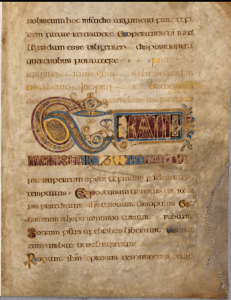
Fol. 13r, From the Book of Kells, Trinity College. Image in the Public Domain
AND NOW, the poem
THE LIBRARY, a subsection of a “Dublin Suite: Homage to James Joyce” by John Logan
This massive, carved medieval harp of Irish oak
no longer sounds in the winds from ancient times gone
out
of Celtic towns. It rests in the long, high vaulted room
filled up with one million books whose pages chronicle
the works and ages both in our land and in Ireland.
For a hundred years no student has been here above
those huge, leather volumes that burgeon on the balconies
like matched and stacked rows of great pipes
for the unplayed organ of this magnificent place.
But both pipes and harp seem still to come alive and turn
Trinity College Library
into a fantastic temple when we stand over
the twelfth century Book of Kells,
which James Joyce so loved he carried a facsimile
to Zurich, Rome, Trieste. “It is, “
he said to friends, “the most purely Irish thing we have.
You can compare much of my work
to the intricate illuminations of this book.”
Its goat skin pages open up for us under glass
in a wooden case. At this place:
a dog nips its tail in its mouth,
but this dog is of ultramarine, most expensive
pigment after gold, for it was ground out of lapis,
and the tail of the lemon yellow orpriment.
Other figures are verdigris, folium or woad—
the verdigris, made with copper,
was mixed with vinegar, which ate into the vellum
and showed through on the reverse page.
Through the text’s pages turn constant, colored arabesques
of animated initial
letters—made of the bent bodies
of fabulous, elongated beasts
linked and feeding beautifully upon each other,
or upon themselves. Why, even the indigo-haired
young man gnaws at his own entrails.
The archetypal figure of the uroboros
recurs, as does that the Japanese call tomoi:
a circle divided by three arcs from its center.
These illuminations around
the Irish Script of the Gospels
are some of them benign and some terrible like that
Satan from the four temptations:
The devil is black, a skeleton with flaming hair
and short, crumpled emaciated wings, which appear
to be charred as are the bony feet—
and the reptile with such gentle
eyes is colored kermes (compounded from the dried
bodies
of female ants that die bright red).
The covers of jewels and gold are gone from the Book,
stolen for a while from the Kells
Monastery in County Meath
and then found, some of its gorgeous pages cut apart
and the whole stuffed beneath the sod.
These designs were all gestures of the bold minds of
monks—
their devils still whirring about their ears while angels
blasted their inner eyes with colors not in any
spectrum, and moaning, primitive Celtic gods still cast
up out of their hermetic interior lives strange figures
which we can all recognize as
fragments of our inhuman dreams:
all this is emblazoned here in the unimagined
and musical colors of a medieval church.
Ah, friend, look how this Book of Kells
pictures all our heavens, all our hells.
From Logan’s book, The Bridge of Change (BOA Editions, Ltd). With permission from BOA Editions.
 Keeping (and Telling) the Past